A competitor talent map sells something a CV never can: an understanding of how a rival is built. Who's on the team, how it's structured, where the depth is, where the gaps are, and who's reachable. It's intelligence — and clients pay for intelligence differently than they pay for candidates. This is the use case that most clearly separates mapping from recruiting: nobody is being placed, and the agency that can draw the picture looks like a strategic partner rather than a supplier.
Is competitor talent mapping the same as poaching?
No — and the framing is what protects you. Sold as "here are people to poach," a competitor map is legally and reputationally fraught, and it feels cheap. Sold as "here's how your rival's function is built and where it's exposed," it's legitimate competitive intelligence a client will fund from a strategy budget. The deliverable is the structure and the understanding; what the client does with it comes later and separately. For where this sits among other mapping work, see talent mapping vs market mapping vs pipelining.
What a competitor map contains
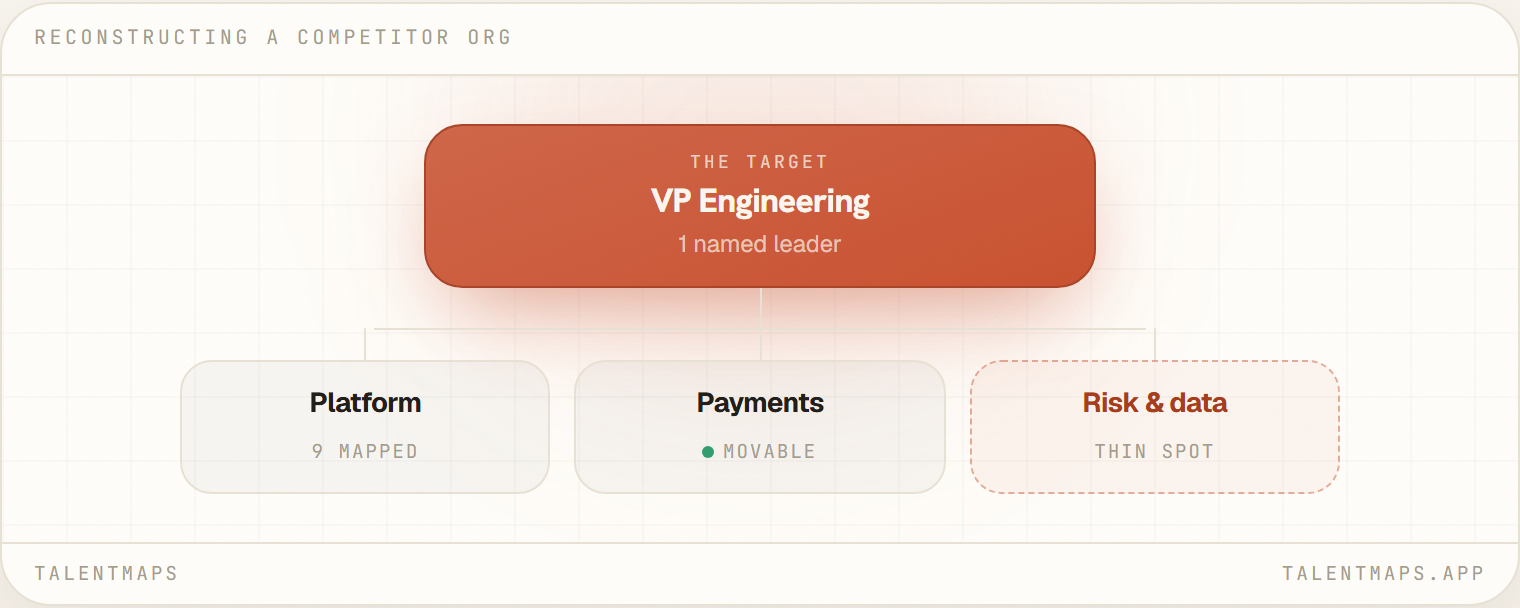
A useful competitor map reconstructs the target function as an organisation:
- Structure and headcount — how the function is built, and how big it is.
- Key people and their remits — who matters, and what they own.
- Seniority distribution — where the experience sits, and where the thin spots are.
- Compensation bands — what it likely costs to compete for this talent.
- Reachability — who's movable, and who's locked in.
- Vulnerabilities — where the rival is over-reliant or exposed.
How to build one
You're reconstructing an org chart from the outside, using public signals and profile data, then structuring it into something a client can read at a glance. The research discipline is the same as any sector map — define the boundary, work the market systematically, present it cleanly — and it's covered step by step in how to market map a sector.
Selling it as a decision input
Price and pitch a competitor map as a strategic deliverable, not a recruitment service. The buyers are clients benchmarking against a rival, planning a counter-hire, or assessing a competitor's capability before a board decision — all funded from strategy budgets rather than a headcount line. A fixed project fee, scaled to the size and depth of the target function, is the right structure. Competitor mapping rarely travels alone: the same strategy budget funds a succession map when a client fears losing a leader, and a market-entry map when they're weighing a new location.
Frequently asked questions
- Isn't competitor mapping just poaching?
- No. The deliverable is the structure and intelligence — how a rival's function is built, where the depth and gaps are, who's reachable — not a list of people to approach. The value is understanding, which the client may use for hiring, benchmarking or strategy. Approaches, if any, come later and separately.
- What does a competitor map contain?
- An org view of the target function: headcount and structure, key people and their remits, seniority distribution, likely compensation bands, and reachability. It tells the client how the competitor wins — or where they're vulnerable.
- Why pay for this instead of a search?
- Because the question is strategic, not a vacancy. A client benchmarking against a rival, planning a counter-hire, or assessing a competitor's capability is buying a decision input — a different and often larger budget than a placement fee.