The August 2026 briefing
Here's the UK hiring market in one line: still soft, but showing the first sign of a floor. Vacancies keep drifting down — outside the pandemic they have not been this low since 2014 — yet permanent placements stopped falling in July after 45 months of decline, temp billings grew for a fourth straight month, and candidates are still everywhere. This archived edition retains its original reporting periods and publisher links. Check the latest releases before using these figures with a client.
Is the UK recruitment market recovering in 2026?
Not recovering — but for the first time in nearly four years it has stopped getting worse. Vacancies are still falling; permanent placements are not. July ended a 45-month run of decline, which makes this a floor rather than an upturn, and it is the first time since 2022 that the two headline indicators have pointed in different directions.
The decline is still the dominant direction, but it is no longer universal: vacancies fell in 9 of the 18 industry sectors in the ONS's latest release, down from 10 the month before. Fewer open roles means the contingent model has fewer shots on goal, and more competition for each one.
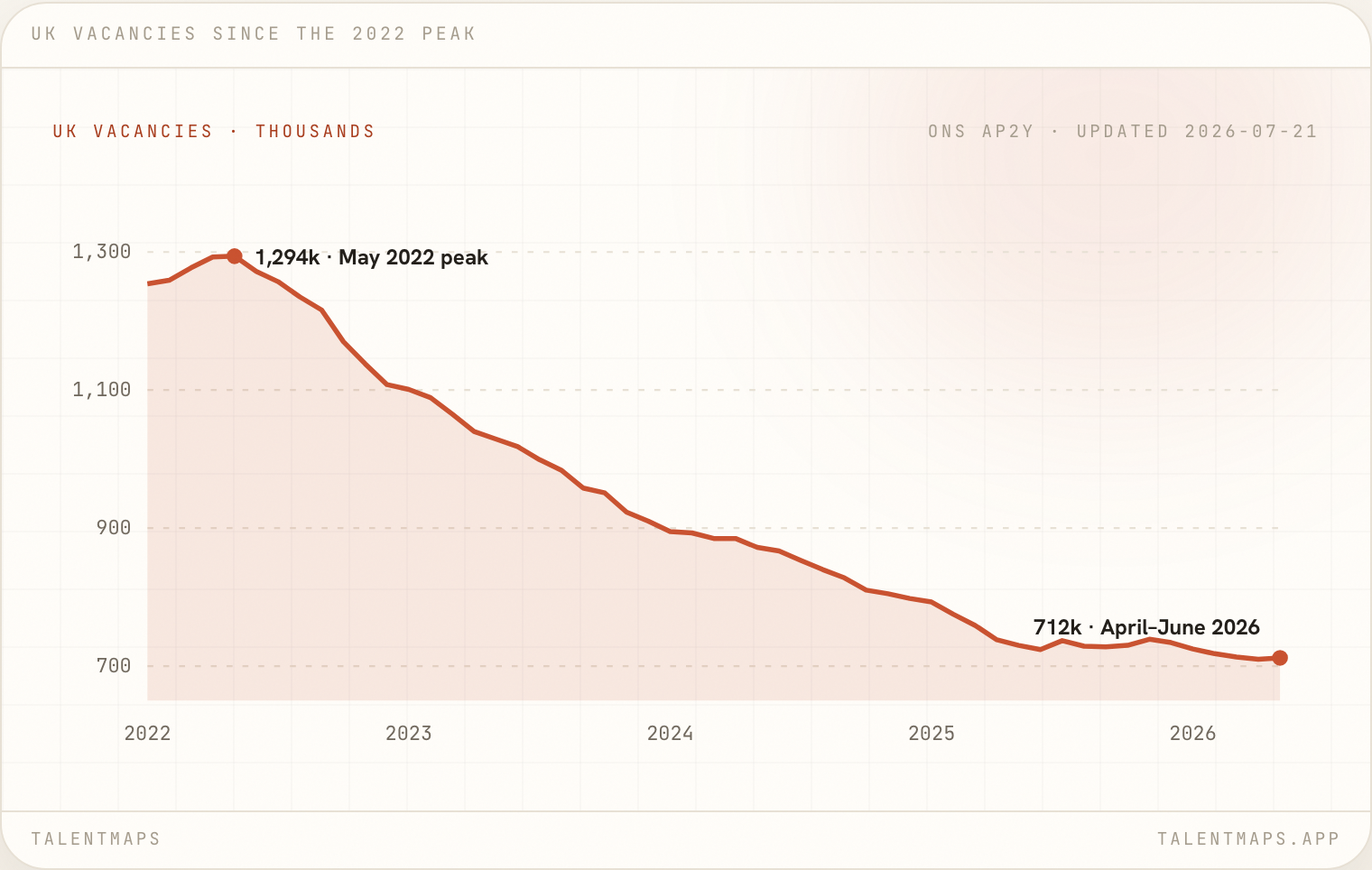
See the complete vacancy trend above
The shape of that line is the context for everything below: not a crash but a long, steady deflation from the 2022 hiring frenzy, now sitting below where it stood before the pandemic distorted everything.
Permanent placements
Forty-five months is not a blip — it reshaped the permanent market, and one flat month does not undo it. Stabilising means placements stopped falling, not that they started growing, and the level they have stabilised at is the one three and a half years of decline left behind. Employers still blame economic uncertainty and the rising cost of employment. Contingent fees remain the revenue most exposed to this, but the direction of travel has at last stopped working against them.
Temporary billings
The money hasn't vanished; it's moved. With permanent commitment still feeling risky, employers buy flexibility first — and in July that showed up in demand as well as billings, with temp vacancies rising for the first time in two years. Temp leading while permanent merely steadies is the clearest single picture of where 2026 demand actually sits.
Candidate availability
Candidate availability increased again in July 2026, driven by redundancies and softer demand. The run of growth now reaches back nearly three and a half years, and KPMG and REC describe the latest rise as “sharp” (KPMG & REC, August 2026).
This is the number that matters most for mapping. When candidates are scarce, your value is access. When they're everywhere — as now — access is worth little, and the value flips to judgement: which of the many available people are worth a client's time, and which of the good ones aren't on the market at all. That's what a map sells.
The wider economy
The labour-market signals around that growth figure point the same way. The OECD expects UK inflation to rise to 3.7% in 2026 and unemployment to reach 5.5% before both ease in 2027 (OECD). Sector by sector it's uneven: construction is in sharp contraction, with the S&P Global UK Construction PMI at 38.2 in May 2026, its weakest since May 2020 (S&P Global).
What it means for your desk
Soft demand and deep candidate supply pull one way: the value an agency adds moves from access to intelligence. When a job ad reaches the same available candidates everyone else sees, the differentiator is a deliberate read of the market — which is what a talent map is. The full down-market case is in talent mapping in a frozen market, and what to charge for a map is anchored in the UK talent mapping fee benchmark.
Sources and method
- Vacancies: ONS, Vacancies and jobs in the UK (monthly).
- Placements, billings, candidate availability: KPMG & REC, UK Report on Jobs, compiled by S&P Global (monthly).
- Macro context: KPMG European Economic Outlook, IMF Article IV, OECD Economic Outlook, S&P Global PMI.
This archive retains the reporting periods and sources recorded in the August 2026 edition. Consult the latest publisher releases for current figures.
The complete dataset
54 monthly observations from the stored ONS AP2Y series. Values are in thousands, seasonally adjusted. Each month is the middle month of a three-month estimate.
View all 54 data points
| Middle month | Vacancies (thousands) |
|---|---|
| 2022 JAN | 1,254 |
| 2022 FEB | 1,259 |
| 2022 MAR | 1,277 |
| 2022 APR | 1,293 |
| 2022 MAY | 1,294 |
| 2022 JUN | 1,272 |
| 2022 JUL | 1,257 |
| 2022 AUG | 1,235 |
| 2022 SEP | 1,216 |
| 2022 OCT | 1,170 |
| 2022 NOV | 1,138 |
| 2022 DEC | 1,108 |
| 2023 JAN | 1,101 |
| 2023 FEB | 1,089 |
| 2023 MAR | 1,065 |
| 2023 APR | 1,040 |
| 2023 MAY | 1,029 |
| 2023 JUN | 1,018 |
| 2023 JUL | 999 |
| 2023 AUG | 984 |
| 2023 SEP | 958 |
| 2023 OCT | 951 |
| 2023 NOV | 923 |
| 2023 DEC | 910 |
| 2024 JAN | 895 |
| 2024 FEB | 893 |
| 2024 MAR | 885 |
| 2024 APR | 885 |
| 2024 MAY | 872 |
| 2024 JUN | 867 |
| 2024 JUL | 853 |
| 2024 AUG | 840 |
| 2024 SEP | 828 |
| 2024 OCT | 810 |
| 2024 NOV | 805 |
| 2024 DEC | 798 |
| 2025 JAN | 793 |
| 2025 FEB | 775 |
| 2025 MAR | 759 |
| 2025 APR | 738 |
| 2025 MAY | 730 |
| 2025 JUN | 727 |
| 2025 JUL | 737 |
| 2025 AUG | 729 |
| 2025 SEP | 728 |
| 2025 OCT | 730 |
| 2025 NOV | 739 |
| 2025 DEC | 734 |
| 2026 JAN | 725 |
| 2026 FEB | 718 |
| 2026 MAR | 713 |
| 2026 APR | 710 |
| 2026 MAY | 711 |
| 2026 JUN | 707 |
Common questions
Where does this data come from?
The chart uses the stored ONS AP2Y series. The August edition links to ONS for vacancies and KPMG & REC for placements, billings and candidate availability. It also records wider-economy forecasts. Check the latest releases and source coverage before relying on those figures.
How often is the snapshot updated?
This is an archive of the August 2026 edition. It does not refresh automatically. The date at the top identifies that edition, not a new data check.
Why does a talent mapping company publish hiring data?
Because the market decides what agencies can sell. When placements are hard, the case for mapping as a paid deliverable gets stronger — and that argument only holds if it rests on real numbers rather than a sales pitch.