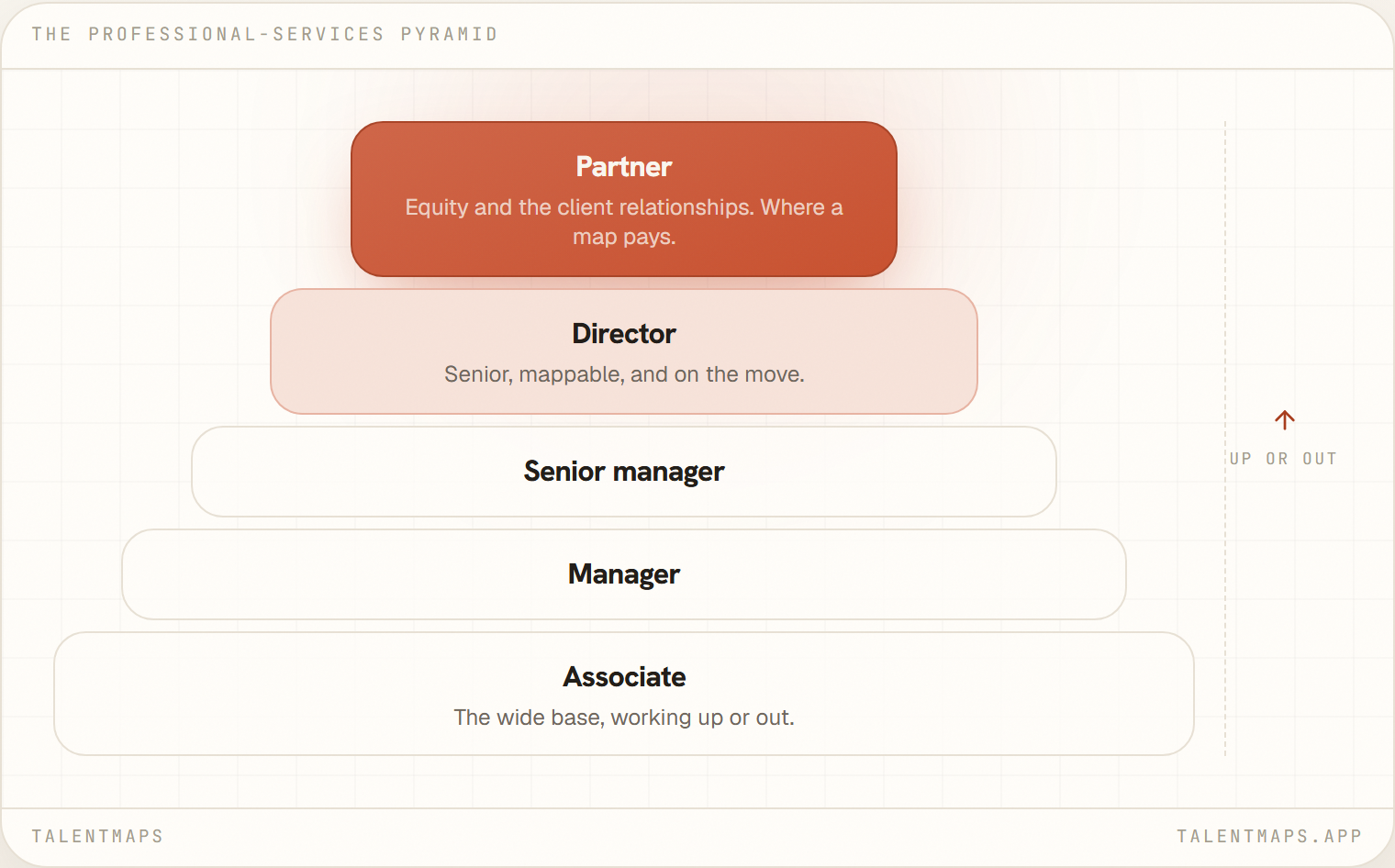
In professional services, the firm is a pyramid, and the value sits near the top of it. Below the partners and directors is a wide base of people working up or out, but the client relationships, the chargeable expertise and the ability to win work concentrate in a small senior layer. A professional-services talent map is a read on that layer: who the credible directors and partners are in a given service line, what they own, and who could move. The firms that grow well don't advertise for partners. They map the market and approach quietly.
That structure is what makes mapping sell into accountancy and advisory firms. A managing partner planning a lateral hire or a team build, or a company building an in-house function out of practice talent, is making a strategic bet and will pay to see the whole board first.
Is there a market worth mapping?
There is, and the scale of the profession is the reason a map matters rather than an obstacle.
The headline number is enormous, and useless on its own. The skill in professional-services mapping is the narrowing: from a profession of hundreds of thousands to the specific transaction-services directors, or restructuring partners, or tax leads at a defined set of firms, whose move would actually matter to the client. That is a question advertising can never answer.
What a professional-services talent map contains
A map here is drawn along two axes, service line and grade:
- Service line — audit, tax, deals and transaction services, restructuring, risk, and the consulting verticals. Talent doesn't transfer freely across them, so the map has to match the client's exact discipline.
- Grade — the rungs from manager through senior manager and director to partner. Where someone sits on the pyramid, and whether they're rising or stalled, is half the story.
- Client relationships and chargeability — at senior grades, who carries the relationships and the book of work, the asset that moves with a lateral hire.
- Compensation and structure — partner profit share and equity, and the progression promises that pull people between firms. As in any partnership — law firms included — base pay alone tells you little.
The competitor set runs from the Big Four through the mid-tier firms and the boutiques to in-house finance and advisory teams, with a steady current of talent flowing from the Big Four into industry — and, at the deals end, into private equity. That alumni flow is itself mappable, and often where the best hires sit. Reconstructing how a rival firm's service line is built is competitor talent mapping; for the deliverable, see what goes in a market map.
Why professional services clients commission a map
The briefs follow the firm's growth and the regulatory weather:
- A lateral partner hire or team build in a service line, where the firm wants the full field before it approaches anyone.
- A new service line or office that needs to be staffed from the market.
- An in-house build by a company poaching audit, tax or deals talent out of practice.
- Partner succession as a senior figure approaches retirement and the relationships need an heir, quietly. That's succession talent mapping in a firm.
Each is a partner-level or board decision, funded as intelligence rather than a placement fee.
How to build one
The method is the same as any sector map, set out in how to market map a sector. Sharpen it for the profession.
The professional-services-specific moves: map by service line and grade, because a map that ignores the pyramid is just a name list. Track the up-or-out flow and the regulatory shifts, audit reform and rotation rules move senior people in predictable ways, so they double as a hiring signal. And treat the Big Four alumni network as a feeder pool worth mapping in its own right.
Pricing it, and turning it into a search
Price it as a fixed fee scaled to the service lines and seniority it covers, not a day rate, and reflect the discretion senior work demands. The packaging and pricing are in how to sell talent mapping as a service.
And position the follow-through. A firm that paid you to map a service line before it moved is the obvious agency to run the lateral hire or the team build it sets up. The map is what you bill now; the placement is the larger fee it lines up.
Frequently asked questions
- What makes professional services talent mapping different from a normal sector map?
- The up-or-out pyramid and service-line specialisation. The profession is enormous, but within a single service line, audit, tax, deals, restructuring or a consulting vertical, at director or partner level, the credible pool is small and the people are constantly being pushed up or moved out. A map works at service line plus grade, and it tracks the steady flow of talent from the Big Four into the mid-tier and into industry.
- Who buys a professional services talent map?
- A firm planning a lateral partner hire or a team build in a service line, a firm benchmarking its structure and pay against rivals, or a company building an in-house finance or advisory function by hiring out of practice. The budget is strategic, because the work sits above any single vacancy.
- The profession has hundreds of thousands of members. Is it really mappable?
- That scale is exactly why mapping beats advertising. There are over 408,000 accountancy-body members across the UK and Ireland, but a useful map zooms to one service line at one grade, where the real pool is small and named. The pyramid and regulatory shifts keep senior people moving, and a map catches them mid-move.